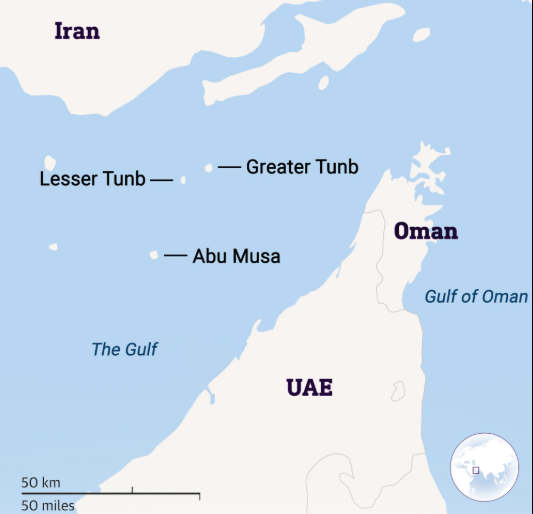
 Esmaeil Baghaei, woordvoerder van het Iraanse ministerie van Buitenlandse Zaken, heeft opnieuw de claim van de Verenigde Arabische Emiraten (VAE) op drie door Iran gecontroleerde eilanden in de Perzische Golf veroordeeld. Dit gebeurde nadat Canada zijn steun had uitgesproken voor het standpunt van de Emiraten.
"De VAE werden opgericht in 1971. Toch claimt het land – ondanks overweldigend historisch bewijsmateriaal, geografische feiten en gedocumenteerde gegevens over Abu Musa, de Grote Tunb en de Kleine Tunb – deze IRAANSE eilanden, die al millennia lang deel uitmaken van IRAN", aldus Baghaei op X.
"Opmerkelijk genoeg heeft de Canadese premier ervoor gekozen om deze absurde claim te herhalen!" voegde Baghaei eraan toe.
"Is territoriale integriteit en respect voor historische en juridische feiten een fundamenteel principe voor Canada, of geldt dit alleen wanneer de eigen soevereiniteit van Canada op het spel staat? Beseft Canada niet dat het hiermee in feite de tak afzaagt waarop het zelf zit?"
In een gezamenlijke verklaring eerder deze week riepen de Canadese premier en de president van de VAE, sjeik Khaled bin Mohamed bin Zayed Al Nahyan, op tot een einde aan de "bezetting" van de drie eilanden. Volgens hen schendt deze situatie de soevereiniteit van de VAE en de beginselen van het VN-Handvest.
OORSPRONG VAN DE CLAIM
Abu Musa, de Grote Tunb en de Kleine Tunb kwamen in Iraanse handen door een combinatie van factoren: de terugtrekking van het Britse leger, reeds bestaande historische aanspraken, een overeengekomen gezamenlijke regeling voor één eiland, en een militaire inname van de andere twee – dit alles vlak voor de oprichting van de Verenigde Arabische Emiraten (VAE) in november 1971.
Kort voor het Britse vertrek onderhandelde Iran met de heerser van het emiraat Sharjah (dat aanspraak maakte op Abu Musa). In november 1971 ondertekenden zij een memorandum van overeenstemming (bron: Wikipedia). Hierin werd vastgelegd dat Iraanse troepen op delen van Abu Musa mochten landen en zich daar mochten stationeren, terwijl de kwestie van de uiteindelijke soevereiniteit onopgelost bleef en Sharjah financiële steun ontving.
Met de heerser van Ras al-Khaimah – het emiraat dat aanspraak maakte op de Grote en de Kleine Tunb – kon geen overeenstemming worden bereikt. Op 30 november 1971 – slechts twee dagen voor de officiële oprichting van de Verenigde Arabische Emiraten (VAE) op 2 december 1971 – landde de keizerlijke Iraanse marine op de Tunb-eilanden. Op Groot-Tunb kwam het tot gewapend verzet, waarbij slachtoffers vielen, waarna Iran de volledige militaire controle over de eilanden overnam.
Teheran beschouwt de eilanden als een onlosmakelijk deel van Iran. Daarbij wordt verwezen naar historisch gezag en controle door oude Perzische rijken (zoals tijdens de Sassanidische en Kadjaren-periodes), met het argument dat de lokale sjeikdommen destijds geen soevereine staten waren. Bovendien heerst er in pro-Iraanse kringen – zoals ook blijkt uit discussies op platforms als Quora – de opvatting dat de herbezetting van de eilanden in feite slechts een herstel was van de reeds bestaande nationale soevereiniteit.
De VAE (die de aanspraken van Sharjah en Ras al-Khaimah hebben overgenomen) beschouwen de eilanden als illegaal bezet emiraatgrondgebied. Zij voeren aan dat de Qasimi-stam al sinds de 18e eeuw onafgebroken controle over de eilanden uitoefende en dat de afspraken uit 1971 onder politieke dwang tot stand kwamen. De VAE hebben herhaaldelijk geprobeerd het geschil op te lossen via bilaterale onderhandelingen of via het Internationaal Gerechtshof; opties die Iran echter steevast afwijst.
MIJN VISIE
Als een land territoriale aanspraken maakt op een gebied terwijl het land vóór de staatsvorming in 1971 niet bestond, is de nieuw gevormde staat dan ook de rechtmatige eigenaar van het gebied dat de nieuwe staat claimt?
Men zou eigenlijk eerst moeten afvragen: hoe en wanneer kwam de Perzische Golf onder Britse controle? Dat was in 1822, en was de Britse overheersing van de Perzische Golf meer gelinkt aan het westen van de Britse kolonie India.
De vraag die je eerst moet stellen is dan ook: tot welk land behoorden die eilanden voordat de Britten de Perzische Golf gingen heersen? Je moet dan ver terug in de tijd, en dat doen Canada, Italië en de VAE niet.
De discussie lijkt dan ook op die over Palestina, waarbij de Israeliers claimen dat het land altijd joods is geweest, terwijl het land voor de Britse overheersing 400 jaar lang onder moslimheerschappij stond, waaronder de Ottomanen. Dat laatste wordt om politieke redenen willens en wetens verzwegen en dat gebeurt nu ook over die eilanden.
Abu Musa en de eilanden Groot-Tunb en Klein-Tunb behoorden oorspronkelijk tot het Perzische Rijk (550 v.Chr.) en later tot de Omajjaden-dynastie (661–750 n.Chr.). De geschiedenis van de drie eilanden begint hier, niet wanneer de Britten de controle over de Perzische Golf eindigden. Dit feit wordt door alle drie de landen gewoonweg weggegummed.
Ik stuitte op informatie die suggereert dat de eilanden ook deel uitmaakten van het Ottomaanse Rijk. De sultans zijn Iran echter nooit binnengevallen.
Je zou de emiratische politiek kunnen vergelijken met een oude filmrol. Je knipt gewoon de scènes eruit die je niet wilt laten zien. Je vervalst hiermee de geschiedenis van de drie eilanden uitgerekend tijdens de oorlog tegen Iran.
Het is territoriale regressiepolitiek bedrijven -zeg maar de klok terugzetten naar een periode waarin sprake was van het feit dat een stuk land toebehoorde aan bepaalde voorvaderen, maar in de loop van de eeuwen van de ene hand naar de andere is overgegaan. De voorouders van de Israeliërs, de Europese kolonisten, maakten daar in 1947 een einde aan. De Verenigde Arabische Emiraten doen niet veel anders, zij het dat het gaat om drie eilanden.
Ik zie het gedrag van de Emiraten dan ook in het licht van de Israeliers, die al bekend staan om het misbruiken van elke zelfgecreëerde situatie. Begrijp me niet verkeerd: de VAE creëerde de situatie over de eilanden door zich te laten inspireren door een zionistische claim die sinds 1897 bestaat.
In geografisch opzicht is de decennialang durende onenigheid over Abu Musa en de Grote en Kleine Tunb een complexe zaak, omdat de eilanden ieder een eigen zone van 12 zeemijlen hebben gevormd, die ook nog eens overlappingen vormen met de territoriale wateren van Iran en de VAE. Daarnaast raakt de maritieme zone rond de eilanden de maritieme grenzen en scheepvaartroutes van Oman bij de Straat van Hormuz. Het laatste woord is nog niet gesproken.
|
|
Iran’s Foreign Ministry spokesperson, Esmaeil Baghaei, has again condemned the UAE’s claim to three Iranian-controlled islands in the Gulf, after Canada voiced support for the Emirati position.
“The UAE was established in 1971. Yet, despite the overwhelming historical record, geographical facts and documented evidence concerning Abu Musa and the Greater Tunb and Lesser Tunb, it lays claim to these IRANIAN islands whose history of being part of IRAN stretches back many millennia,” Baghaei said on X.
“Remarkably, Canada’s Prime Minister has chosen to echo this absurd claim!” Baghaei added.
“Is territorial integrity and respect for historical and legal facts a fundamental principle for Canada, or does it matter only when Canada’s own sovereignty is at stake? Does Canada not realize that, in doing so, it is effectively sawing off the very branch on which it sits?”
In a joint statement earlier this week, Canadian Prime Minister Mark Carney and UAE President Sheikh Khaled bin Mohamed bin Zayed Al Nahyan called for an end to the “occupation” of the three islands, which they said violates the UAE’s sovereignty and the principles of the UN Charter.
ORIGIN OF THE CLAIM
Abu Musa, Greater Tunb, and Lesser Tunb came under Iranian control due to a combination of factors: the withdrawal of the British military, pre-existing historical claims, an agreed-upon joint arrangement for one island, and a military seizure of the other two—all occurring just before the establishment of the United Arab Emirates (UAE) in November 1971.
Shortly before the British departure, Iran negotiated with the ruler of the Emirate of Sharjah (which laid claim to Abu Musa). In November 1971, they signed a memorandum of understanding (source: Wikipedia). This agreement stipulated that Iranian forces could land on and be stationed in parts of Abu Musa, while the issue of ultimate sovereignty remained unresolved and Sharjah received financial support.
No agreement could be reached with the ruler of Ras al-Khaimah—the emirate that claimed Greater and Lesser Tunb. On November 30, 1971—just two days before the official founding of the United Arab Emirates (UAE) on December 2, 1971—the Imperial Iranian Navy landed on the Tunb islands. On Greater Tunb, armed resistance ensued, resulting in casualties, after which Iran assumed full military control over the islands.
Tehran considers the islands an inseparable part of Iran. It points to historical authority and control exercised by ancient Persian empires (such as during the Sassanid and Qajar periods), arguing that the local sheikhdoms were not sovereign states at the time. Moreover, within pro-Iranian circles—as evidenced by discussions on platforms like Quora—there is a prevailing view that the reoccupation of the islands was, in fact, merely a restoration of pre-existing national sovereignty.
The UAE (which has adopted the claims originally held by Sharjah and Ras al-Khaimah) considers the islands to be Emirati territory under illegal occupation. They argue that the Qasimi tribe had exercised continuous control over the islands since the 18th century and that the agreements reached in 1971 were the result of political coercion. The UAE has repeatedly sought to resolve the dispute through bilateral negotiations or the International Court of Justice—options that Iran has consistently rejected.
MY VIEW
If a country lays territorial claim to an area, yet that country did not exist prior to its formation as a state in 1971, can the newly formed state truly be considered the rightful owner of the territory it claims?
One should first ask: how and when did the Persian Gulf come under British control? This occurred in 1822, and British dominance over the Persian Gulf was largely linked to the western reaches of British-ruled India.
Consequently, the fundamental question that must be asked is: to which country did these islands belong before the British established their dominance over the Persian Gulf? This requires looking far back into history—something that Canada, Italy, and the UAE fail to do.
The discussion is, in fact, similar to the one regarding Palestine, where Israelis claim that the land has always been Jewish—even though, prior to British rule, it was under Muslim governance for 400 years, including under the Ottomans. The latter fact is deliberately and knowingly omitted for political reasons, and the same is now happening with regard to these islands.
Abu Musa and the islands of Greater Tunb and Lesser Tunb originally belonged to the Persian Empire (550 BC) and later to the Umayyad dynasty (661–750 AD). The history of the three islands begins here—not when the British ended their control over the Persian Gulf. This fact is simply erased by all three countries.
I came across information suggesting that the islands were also part of the Ottoman Empire—though the sultans never actually invaded Iran.
One could compare the politics of the United Arab Emirates to an old reel of film: you simply cut out the scenes you do not wish to show. In doing so, they are falsifying the history of these three islands—precisely during a time of conflict with Iran.
It is a policy of "territorial regression"—effectively turning back the clock to a period when a piece of land belonged to certain ancestors, even though it has changed hands many times over the centuries. The ancestors of the Israelis—European colonists—put an end to such historical continuity in 1947. The United Arab Emirates are doing something similar, albeit concerning three islands.
I therefore view the behavior of the UAE in the same light as that of the Israelis, who are already known for exploiting any situation they have created themselves. Do not misunderstand me: the UAE manufactured the situation regarding these islands by drawing inspiration from a Zionist claim that has existed since 1897.
From a geographical perspective, the decades-long dispute over Abu Musa and the Greater and Lesser Tunbs is a complex matter, as each of the islands generated its own 12-nautical-mile zone—zones that, moreover, overlap with the territorial waters of both Iran and the UAE. Furthermore, the maritime area surrounding these islands impinges upon Oman’s maritime boundaries and shipping lanes near the Strait of Hormuz. The final word on this issue has yet to be spoken.
|
